I love games where you argue in court and reason your way to the truth. Above all, I was hooked on the Ace Attorney series through the 2000s and 2010s, and it has had a big influence on this game as well.
Back when I moved to Tokyo to work as an engineer and started living on my own, I didn’t have a single friend there. What kept me going were mystery adventure games on a handheld console.
On the train home from work, at a quiet little Chinese diner late at night, at McDonald’s. Even after I got home, I’d mean to play only “until a good stopping point,” but I had to know what happened next and kept going into the next episode. I remember never getting enough sleep.
There are more and more indie games these days, but it still feels like there aren’t many about trials or courtroom mysteries. The wait for new games in the series I love kept getting longer, and even when games from overseas could be played in Japanese, differences in language and culture sometimes kept me from enjoying them fully. As a fan, that made me a little sad.
So I thought, why not try making one myself? That’s how Singing Attorney began.
Why songs?
In the first prototype, I put a quirky, quiz-loving prosecutor in Episode 1. That turned out to be fun, so I decided every episode would have a quirky prosecutor with some kind of special power. The one I had planned for Episode 2 was a musical prosecutor.
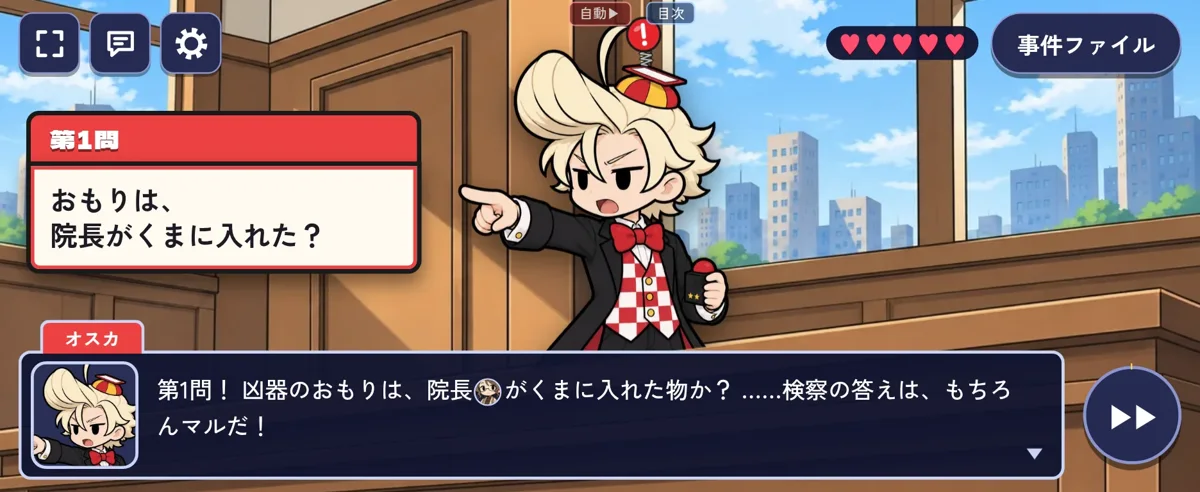
At first, though, the whole idea was just “the prosecutor sings a theory, and you break it with evidence.” The songs got in the way of the deduction, and it didn’t quite work.
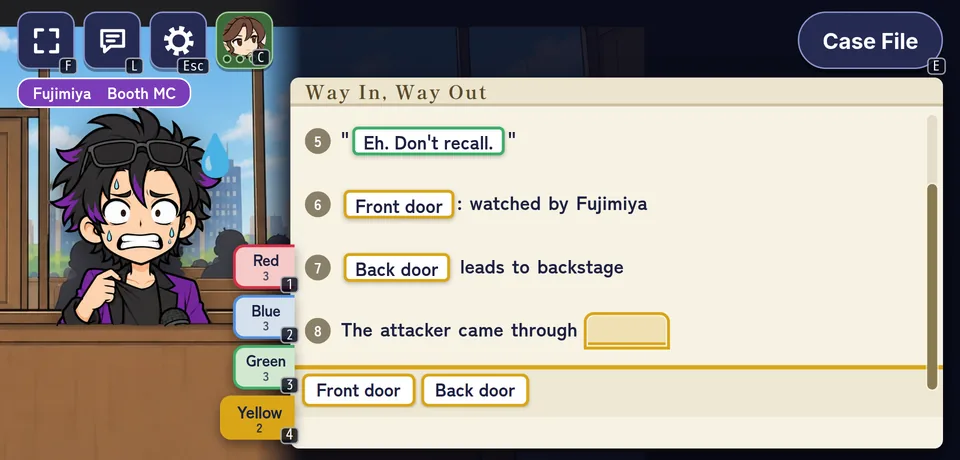
So, strongly influenced by Return of the Obra Dinn and The Case of the Golden Idol, I brought in a system where you place words into a sentence with blanks, and a sentence telling the truth comes together. In this game, that sentence becomes the lyrics, just as it is.
Still, it isn’t fun unless the one who reaches the truth is the main character, which means the player. So I set the prototype’s characters aside and started over, and made Kanade, who I had originally created as a prosecutor, the protagonist. Back then she was a princess-like prosecutor who looked ready to break into a musical number, so she wore a dress. I changed the bottom half to pants and reworked her to look like a lead.
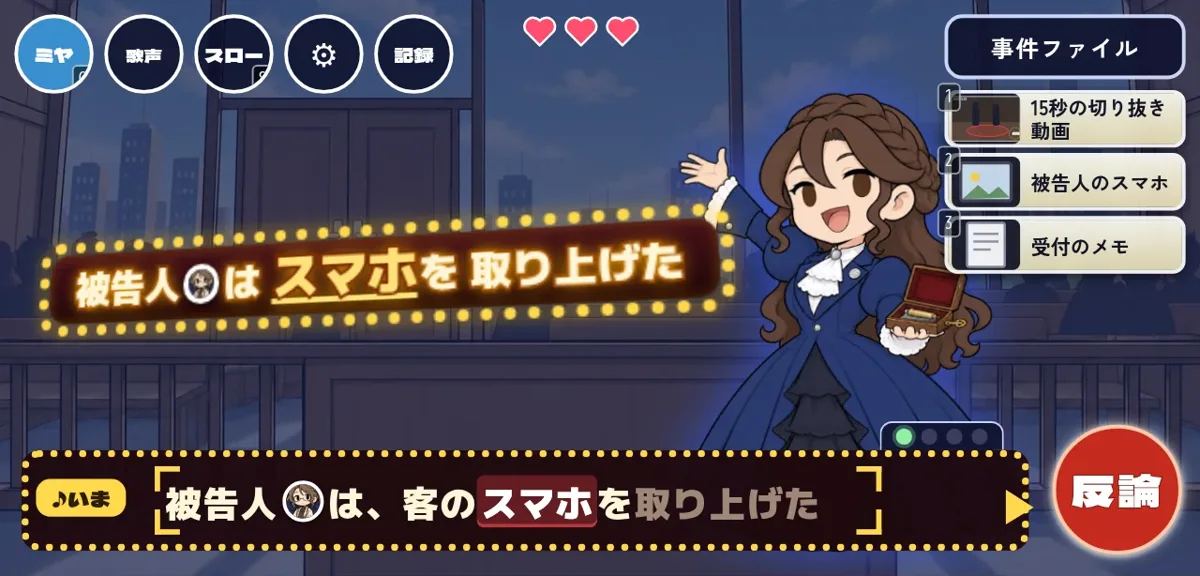
I don’t have any real background or expertise in musicals. But every time I watched the opera house scene in Final Fantasy VI, or a Disney animated film where a character starts singing about how they feel, I’d think how much fun it would be to put that into a mystery game. I’d been thinking that for a long time.
Alone, late at night
I make this game by myself, late at night. I did ask people I know, but the timing didn’t work out, so I thought: then I’ll use everything I know about AI from my day job and try making it myself. That’s how it started. It also helped a lot that I could rework even the smallest details of how the game behaves, as many times as I wanted, in a way I couldn’t have imagined back when I used to write code myself.
What I hope you’ll enjoy
The back-and-forth as a cast of strong personalities argue it out in court, and each one’s circumstances coming into view, little by little, as they argue. That satisfying moment when all the clues planted along the way finally connect into one line. I’d be happy if this game lets you enjoy that side of courtroom mystery adventures.
What I cared about
I’m not good with blood or intense scenes myself, so there’s hardly anything graphic, and I’ve kept things restrained. I tried to make it easy to play for people who don’t like scary scenes, too.
I left out investigation segments and focused on what I love most: the exchanges and conversations in court. I aimed for a length that’s easy to play, with each episode wrapping up one case.
Also, when I read mystery novels or play games with a lot of characters, I often have trouble matching names to faces. So when a character first appears, their name gets a face icon and a theme color, and these show up in the conversation log too. Even if someone hasn’t appeared for a while, I wanted every mention of their name to work as a little reminder.
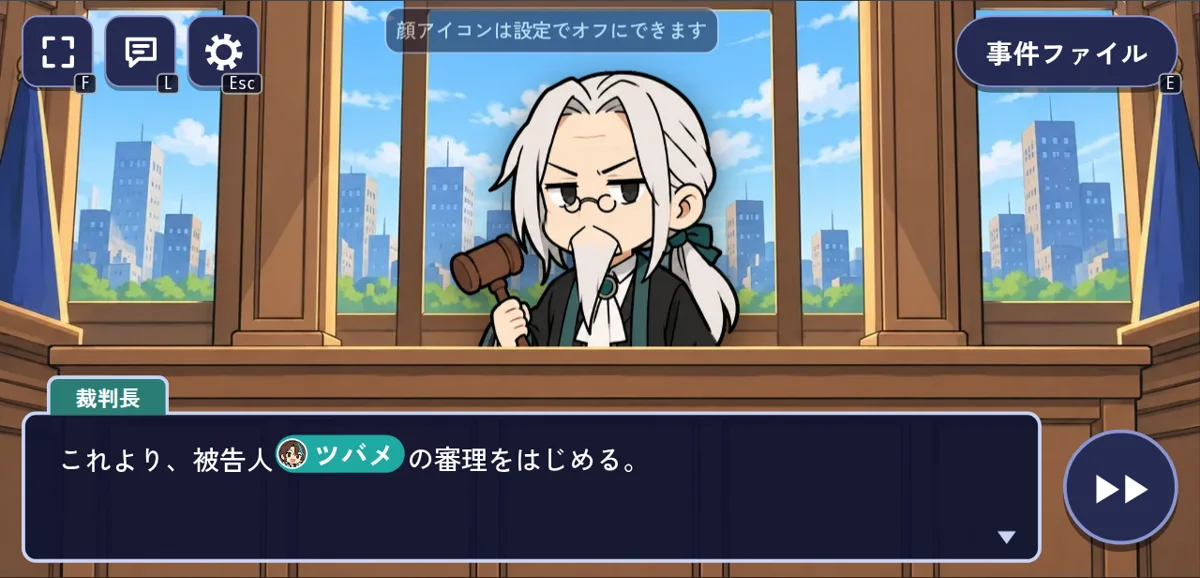

The courtroom in this game is nothing like a real trial. Voices fly in from the gallery, and the prosecutor and the defense burst into song. I’d be happy if you could take it as that kind of world and enjoy it.
MANICHI GAMES
